Medical content review by Dr. Md. Nasir Uddin in progress.
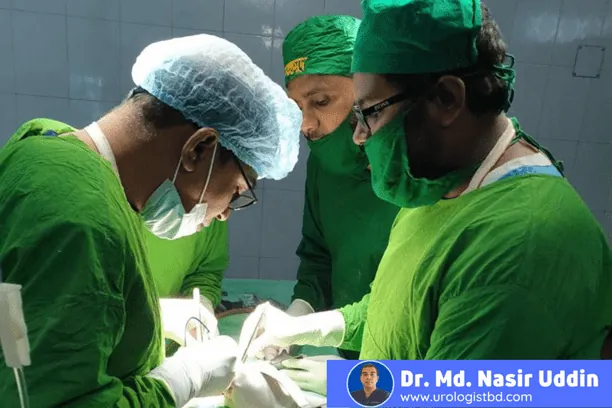
With age, the prostate gland often enlarges and squeezes the urinary passage, making urine slow, frequent and incomplete. Many men do well on medicines; others need an endoscopic operation (TURP or laser) that removes the blocking tissue without a cut.
Symptom checklist
Tick what applies to you and share it at your consultation.
You ticked 0 symptom(s). It is worth having these assessed by a urologist.
Ask for an appointment on WhatsAppConditions treated
- Benign prostatic hyperplasia (BPH)
- Acute or chronic urinary retention
- Prostatitis
- Raised PSA — assessment
Treatment options
Lifestyle and medicines
Alpha-blockers relax the prostate; 5-alpha-reductase inhibitors can shrink it over months.
TURP
The standard endoscopic operation: the obstructing tissue is removed through the urinary passage, with no skin cut.
Laser prostate surgery
Laser enucleation or vaporisation of the prostate — an option for selected patients, including some on blood thinners.
Catheter care
Relief of urinary retention and planning of definitive treatment.
PSA and prostate assessment
Examination, ultrasound and blood tests to separate simple enlargement from conditions needing further tests.
The right option depends on your examination and tests; not every option suits every patient.
Before & after care
Before treatment
- Note how often you pass urine by day and night for three days (a bladder diary)
- Bring PSA, ultrasound and urine reports
- Tell the doctor about blood thinners — they may need to be adjusted before surgery
After treatment
- A catheter is usually kept for a short time after surgery
- Drink plenty of water and avoid straining or heavy lifting for 3–4 weeks
- Some blood in the urine can come and go for a few weeks
- Semen may flow backwards (retrograde ejaculation) after prostate surgery — ask the doctor about this before surgery
Seek urgent care if
- Unable to pass urine with a painful, full bladder
- Fever with urinary symptoms
- Heavy bleeding with clots or a blocked catheter
Go to the nearest emergency department, or call 01337-443602.
Questions about prostate enlargement (bph)
Is an enlarged prostate the same as prostate cancer?
No. Benign enlargement (BPH) is very common with age and is not cancer. A PSA blood test and examination help decide whether further tests are needed.
When is surgery needed for BPH?
Surgery is advised when medicines do not help enough, or if there is urinary retention, repeated infection, bladder stones, bleeding or effects on the kidneys.
Will prostate surgery affect sexual function?
Erections are usually preserved after TURP or laser surgery. Many men notice "dry" orgasm (retrograde ejaculation). Discuss this with the doctor before the operation.